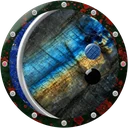
the star itself
Cepheids pulse — bluer as they brighten. Hubble used exactly those stars in M33 to prove it lies outside our galaxy. Eclipses dip, flares jump.
nu.waves · nu.universes
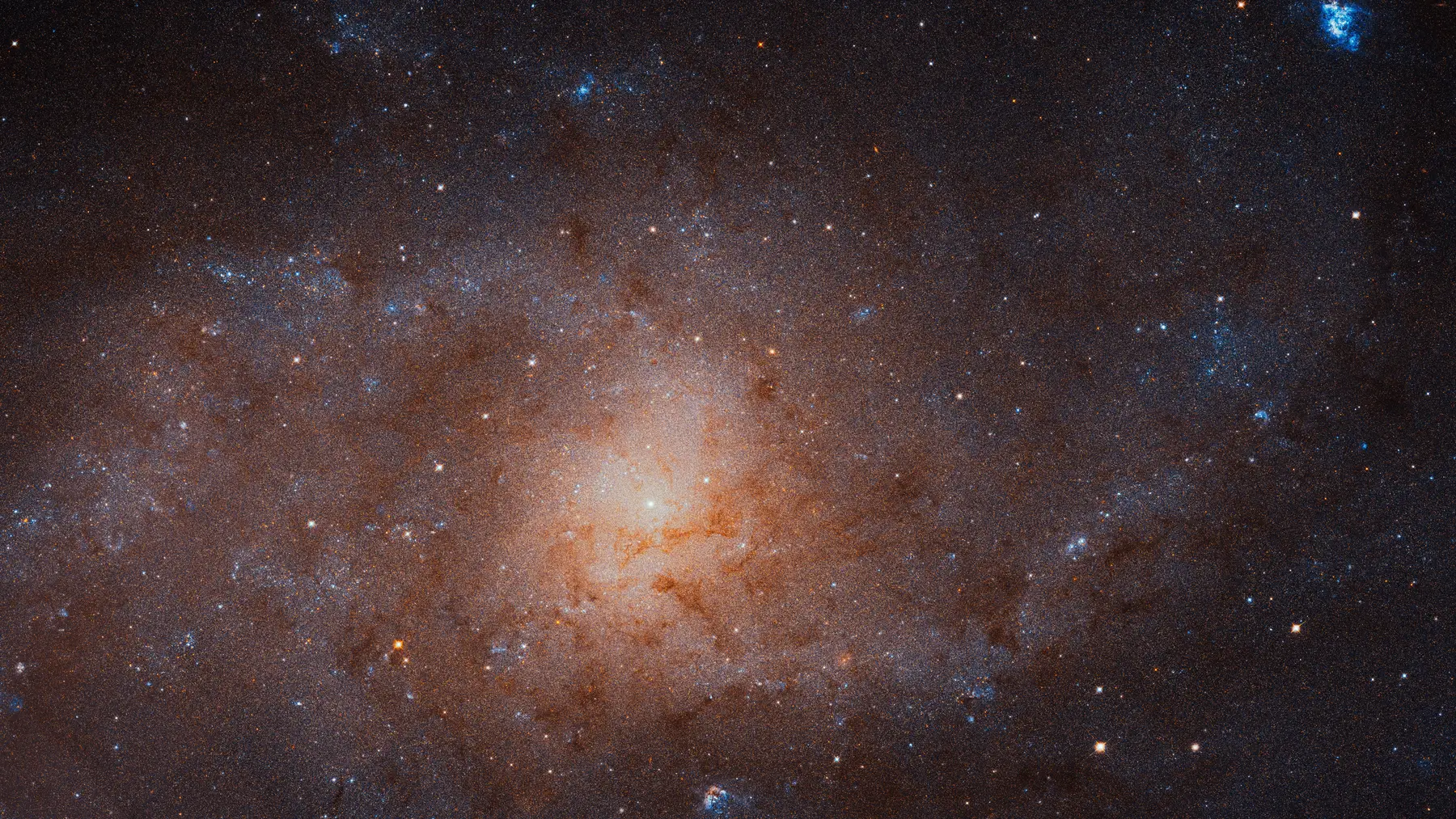
The whole universe since the Big Bang — and where real physics predicts it goes next. Start with the galaxy behind this page: the Triangulum Galaxy, M33, live from the Hubble archive. Music is only the audible band. Here you tune light the same way.
Background: M33 Hubble mosaic · 54 pointings · 665 Mpx · NASA, ESA (ESA/Hubble heic1901)
live map · real distances
One continuous 3D map, in parsecs, from Earth's orbit to the cosmic web. The planets are where NASA JPL's orbital elements put them today. 42,246 stars from the Hipparcos-based HYG catalogue sit at their measured distances. 869 nearby galaxies use measured distances from the Updated Nearby Galaxy Catalog, and 43,415 more are placed by redshift from the 2MASS Redshift Survey. M33 carries the real Hubble mosaic, at its real distance, size and tilt. Scroll to zoom, drag to turn, search to fly.
The Milky Way is a labelled model: nobody has photographed it from outside. Positions are from the catalogues, and the build script is design/nu-universes/catalog.py in khensu-specs. The app flies the same map in RealityKit, with AR: put M33 on your table, or point your phone at the real sky. At magnitude 5.7 M33 is a binocular challenge, 15° from Andromeda past the star Mirach.
wavelength
Gamma ray to radio is one spectrum, tuned like pitch. Pick a band — the same galaxy changes shape, because in ultraviolet it is a different shape.
Visible · true colour. The Hubble mosaic as your eyes would see it.
Mantis shrimps keep 12 colour channels — ultraviolet to red — plus polarisation, in 16 photoreceptor types. nu.u renders 19 channels and re-projects them for your eyes: spectra you call one colour separate here. No new data was downloaded. The same galaxy, for a different animal.
12 spectral strips, UV → red. In the app each strip is the real measured band.
time
Scrub 13.8 billion years: the cosmic microwave background cools from 3,000 K orange to today's 2.7 K microwaves, galaxies form and merge. Forward is prediction, labelled prediction — M33 drifts toward Andromeda, and in about 4 billion years may join the Andromeda–Milky Way encounter, be torn apart, or be thrown out. Physics decides; nu.u shows its working.
Today · 13.8 Gyr after the Big Bang
why stars twinkle
Cepheids pulse — bluer as they brighten. Hubble used exactly those stars in M33 to prove it lies outside our galaxy. Eclipses dip, flares jump.
Turbulence bends starlight. That is the twinkle you know — planets, being discs, stay steady, and Sirius flashes colours. In space it stops.
Faint Hubble stars flicker because photons arrive one at a time. Zoom in far enough and you watch statistics.
get it
RealityKit and AR on iPhone, iPad and Mac (iOS 26). Nothing is processed on servers. Open nu.waves, tap Universes.
Data: ESA/Hubble heic1901 · NASA Messier 33 · ESO · EarthSky. Spec: design/nu-universes.md in khensu-specs.